Not necessarily. The Treaty of Trianon changed the citizenship of many people living in territories transferred from Hungary to neighboring states. Citizenship generally depended on municipal affiliation rather than birthplace, although exceptions and rights of option applied. Some individuals later reacquired Hungarian citizenship. If citizenship passed continuously through the generations, descendants may qualify for citizenship verification. Otherwise, simplified naturalization may be possible if they meet the relevant requirements.

Your ancestor was born in Hungary before 1920. Does that mean you qualify for Hungarian citizenship today?
Not necessarily.
Consider a child born in Nagyvárad in 1915 whose parents had emigrated from Galicia, then part of the Austrian half of the Austro-Hungarian Monarchy.
Although the child was born in the Kingdom of Hungary, the family may never have acquired Hungarian citizenship. Hungarian citizenship law was based primarily on descent, not birthplace. If the parents remained Austrian citizens, their child would not ordinarily have acquired Hungarian citizenship simply by being born in Nagyvárad.
Historical birth registers sometimes contain a marginal annotation (széljegyzet) referring to the family's foreign citizenship or legal status. Such a notation can provide valuable evidence that the child and the parents were not Hungarian citizens.
But what if there is no such annotation?
The absence of a notation does not prove Hungarian citizenship. However, it leaves open the possibility that the parents, or an earlier generation, acquired Hungarian citizenship.
Further research into municipal affiliation (községi illetőség), residence, naturalization records, and other historical documents may establish that a Hungarian citizenship connection existed.
If citizenship was acquired and passed continuously through subsequent generations, descendants may qualify for Hungarian citizenship verification.
If the citizenship chain was interrupted, or the family's connection to historical Hungary provides another qualifying basis, simplified naturalization may be available.
Establishing whether an ancestor was ever Hungarian is therefore the first step.
For families originating in territories that changed sovereignty following the First World War, there is a second question: what happened to their Hungarian citizenship after the Treaty of Trianon?
How Did the Treaty of Trianon Affect Hungarian Citizenship?
The Treaty of Trianon was signed on June 4, 1920, and entered into force on July 26, 1921.
It fundamentally changed the borders of Hungary, transferring substantial territories of the former Kingdom of Hungary to neighboring states.
These included territories that are now part of Slovakia, Romania, Serbia, Ukraine, and other countries.
But the consequences of Trianon extended beyond geography.
The treaty also regulated the nationality of the people connected to those territories.
Under Article 61, individuals possessing legally recognized municipal affiliation in territories transferred to another state generally acquired the nationality of the state exercising sovereignty over that territory, to the exclusion of Hungarian citizenship.
This meant that someone who had been a Hungarian citizen before the treaty could lose Hungarian citizenship and acquire another nationality without ever leaving their home.
The borders changed, and the legal citizenship of many inhabitants changed with them.
However, the treaty contained exceptions and provisions allowing certain individuals to choose another nationality.
Determining which rules applied to an ancestor requires an understanding of historical Hungarian citizenship law and the legal significance of municipal affiliation.
Why Municipal Affiliation Matters More Than Birthplace
One of the most important concepts in citizenship cases involving the Treaty of Trianon is községi illetőség.
This was a legally recognized affiliation with a particular municipality.
It was not necessarily identical to a person's birthplace or place of residence.
Under the treaty, municipal affiliation played a central role in determining nationality following the territorial changes.
Consider two men born in Kassa, now Košice, Slovakia, in 1885.
Both were born in the Kingdom of Hungary.
The first retained municipal affiliation in Kassa, which became part of Czechoslovakia.
Under the general provisions of the treaty, his Hungarian citizenship would have been replaced by Czechoslovak nationality, subject to the relevant exceptions.
The second man, although also born in Kassa, had established municipal affiliation in Budapest before the treaty came into effect.
His citizenship situation could be entirely different because Budapest remained within Hungary.
The two men shared the same birthplace, but their citizenship histories were not necessarily the same.
This is why a Hungarian birth certificate alone cannot always establish that an ancestor remained a Hungarian citizen after 1921.
An Important Exception: Municipal Affiliation Acquired After January 1, 1910
Article 62 of the Treaty of Trianon introduced a particularly important qualification.
It concerned people who acquired municipal affiliation after January 1, 1910, in territories transferred to Czechoslovakia or the Kingdom of Serbs, Croats and Slovenes.
Under this provision, they did not automatically acquire the nationality of the successor state without its permission.
If permission was refused or not requested, their nationality generally followed the state exercising sovereignty over the territory where they had previously held municipal affiliation.
For example, an individual who transferred municipal affiliation from Budapest to a town in the territory of the future Czechoslovakia in 1912 might be treated differently from someone whose family had belonged to that town for generations.
In such cases, the exact date and history of municipal affiliation could determine the outcome.
This provision demonstrates why citizenship research sometimes requires reconstructing an ancestor's movements and legal connections long before the Treaty of Trianon came into force.
What Was the Right of Option (Opció)?
The Treaty of Trianon also provided certain individuals with the opportunity to choose a nationality different from the one they would otherwise acquire following the territorial changes.
This was called the right of option, or opció.
Under Article 63, qualifying adults who lost Hungarian citizenship and acquired another nationality under Article 61 could exercise an option, within one year of the treaty entering into force, for the nationality of the state in which they had previously held municipal affiliation.
Article 64 established a separate right of option for certain ethnic and linguistic minorities, subject to different conditions and a shorter deadline.
The treaty also regulated the residence consequences of exercising an option.
For Hungarian citizenship purposes, it was essential that the option was exercised and recognized in accordance with the applicable requirements.
Historical option certificates can therefore be decisive evidence in modern citizenship cases.
Could an Option Affect the Citizenship of Children?
Yes.
The treaty provided that, under Article 63, a husband's option extended to his wife and a parent's option extended to children under eighteen.
Consequently, a single option could affect the citizenship of an entire family.
When examining a case today, it may be necessary to establish whether an ancestor exercised an option and which family members were covered by it.
For descendants born decades later, this historical decision may determine whether Hungarian citizenship continued through the family.
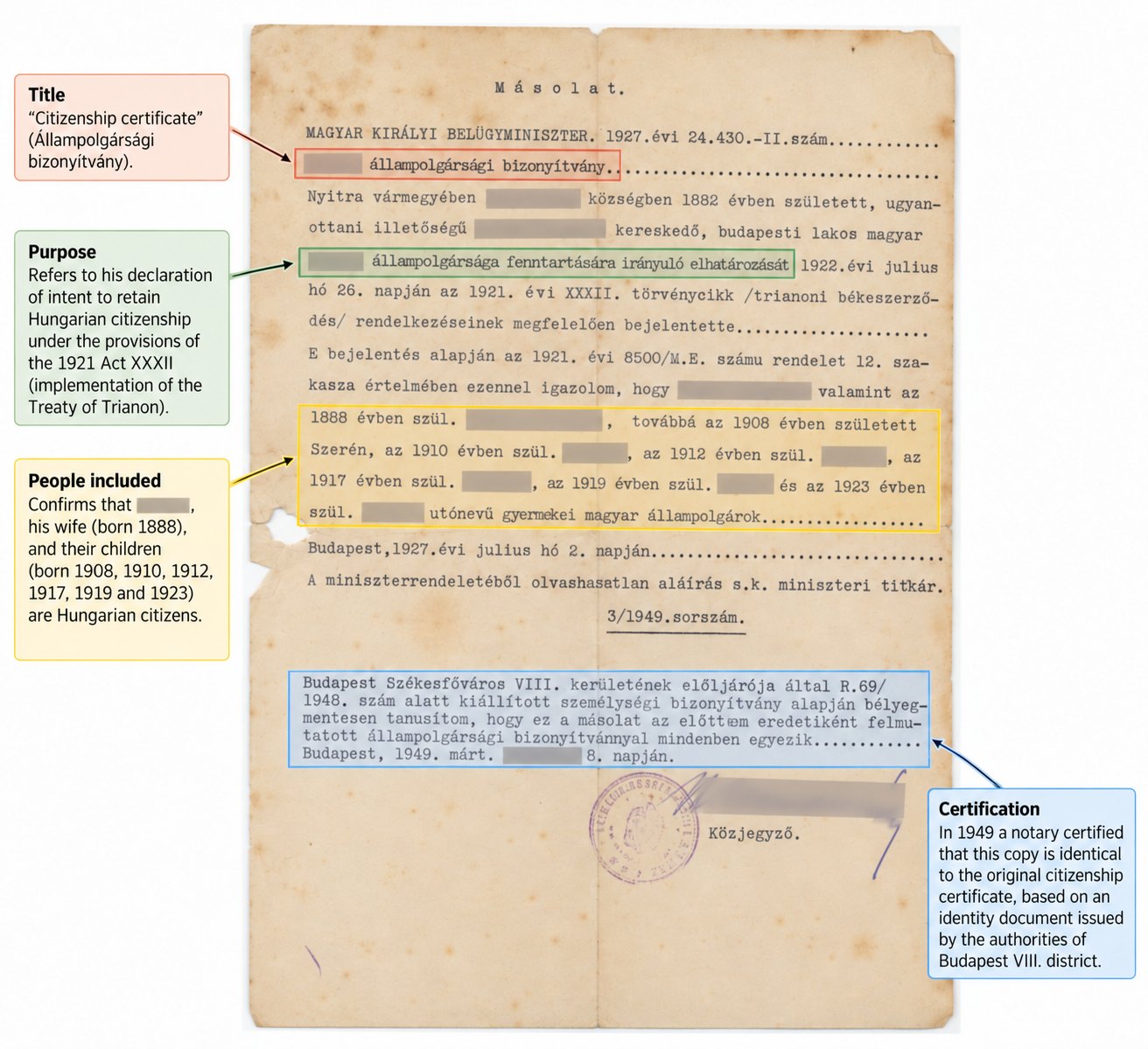
What If the Option Certificate Has Disappeared?
A particularly interesting aspect of historical citizenship research is that the original citizenship file may no longer exist.
The surviving historical citizenship files are incomplete, although records from 1933 onward are substantially better preserved.
An ancestor may have exercised the right of option and received official confirmation, but the original certificate may have disappeared from the family's possession.
That does not necessarily mean the evidence is irretrievably lost.
Valuable alternative sources exist, for example, the supporting documents submitted for civil registration, particularly interwar marriage registrations.
Why Marriage-Registration Files Can Be Important
When a marriage was registered in Hungary, the authorities needed to establish the parties' legal status, including their citizenship.
The supporting documents could include copies of citizenship certificates, option certificates, or other official evidence.
These documents were sometimes retained in the underlying registration file, known as the anyakönyvi alapiratok.
Consequently, even if the original option certificate has disappeared, a copy may survive among the documents supporting a marriage registration.
This is an important difference between obtaining an ordinary marriage certificate and examining the original supporting file.
A marriage certificate establishes the marriage and identifies the parties.
The supporting documents may reveal how their citizenship was established at the time.
In complex Hungarian citizenship cases, these archival records can be more significant than the certificate itself.
Other useful sources may include historical passports, citizenship certificates, municipal-affiliation records, address registrations, and administrative correspondence.
The objective is to reconstruct the ancestor's legal citizenship status from the evidence that survives.
Did Some People Become Hungarian Again Between 1938 and 1941?
The consequences of the Treaty of Trianon did not end in 1921.
Between 1938 and 1941, Hungary regained control of several territories that had been transferred to neighboring states following the First World War.
These territorial changes included parts of southern Slovakia, Carpathian Ruthenia, Northern Transylvania, and territories formerly administered by Yugoslavia.
Hungarian legislation regulated the citizenship of the inhabitants of these territories.
Under certain conditions, people who had previously lost Hungarian citizenship following Trianon could reacquire it automatically through the operation of law.
However, the relevant conditions varied by territory and period.
For several territories, the applicable legislation examined whether a person had been resident there for a prescribed period before the territorial change.
Northern Transylvania was subject to a different rule, under which permanent residence on August 30, 1940, was particularly important.
The legal consequences therefore depended not merely on where an ancestor was born, but also on where they lived and which citizenship legislation applied.
Someone who lost Hungarian citizenship after Trianon could have reacquired it during the territorial changes of 1938–1941.
But that was not necessarily the end of the story.
What Happened After the Second World War?
The territorial arrangements established between 1938 and 1941 were reversed following the Second World War.
The armistice agreement of January 20, 1945, required Hungary to withdraw from territories acquired during the war, and subsequent peace arrangements confirmed the restoration of the earlier borders, subject to certain adjustments.
These changes also affected citizenship.
The distinction between citizenship restored automatically through territorial legislation and citizenship acquired through an individual naturalization or re-naturalization decision became particularly important.
An individual re-naturalization could have legal consequences different from an automatic restoration of citizenship arising from territorial annexation.
Someone whose Hungarian citizenship was restored solely under territorial legislation might have lost that status again after the war.
Someone who acquired citizenship through an individual administrative decision could have retained it, provided no other legal ground for its loss applied.
Later legislation also addressed the citizenship status of people affected by the territorial changes.
For descendants researching citizenship today, it may therefore be necessary to examine a sequence of events extending over several decades.
An ancestor might have been Hungarian before Trianon, lost Hungarian citizenship in 1921, reacquired it in 1940, and experienced another change in legal status after 1945.
The specific legal basis for each change is essential.
Two Families From the Same Town, Two Different Citizenship Histories
Consider two hypothetical families whose ancestors were born in Northern Transylvania in 1905.
Both ancestors were Hungarian citizens at birth.
Following the Treaty of Trianon, both acquired Romanian citizenship under the applicable provisions.
In 1940, Northern Transylvania returned to Hungarian administration, and both ancestors reacquired Hungarian citizenship under the territorial legislation.
Following the Second World War, the territorial arrangements were reversed, and Northern Transylvania returned to Romania.
The first ancestor moved to Hungary after the war.
He settled permanently within Hungary's postwar borders and maintained his permanent residence there on both January 1, 1948, and February 1, 1949.
Under Section 26 of Act LX of 1948, he qualified for recognition as a Hungarian citizen with effect from January 20, 1945.
Consequently, his Hungarian citizenship was recognized as continuing without interruption from that date, despite the reversal of the territorial changes.
The second ancestor remained in Northern Transylvania.
He had also reacquired Hungarian citizenship in 1940, but following the reversal of the territorial arrangements in 1945, he lost the Hungarian citizenship acquired through the territorial legislation.
Because he continued living in Romania, he did not satisfy the permanent-residence requirements of the 1948 law that would have allowed his Hungarian citizenship to be recognized.
Although both men were born in the same town, were Hungarian citizens before Trianon, and reacquired Hungarian citizenship in 1940, their citizenship histories developed differently after the Second World War.
The first ancestor could subsequently transmit Hungarian citizenship to his children, provided the applicable citizenship laws permitted its transmission and no later loss occurred.
The second ancestor could not transmit Hungarian citizenship to children born after he had lost it, unless he subsequently reacquired Hungarian citizenship.
For their descendants today, this distinction can determine whether they qualify for Hungarian citizenship verification or must pursue simplified naturalization.
The decisive factor was not where the ancestors were born, but where they established and maintained their permanent residence following the Second World War.
What Does the Treaty of Trianon Mean for Hungarian Citizenship by Descent Today?
For descendants of families originating in the former Kingdom of Hungary, the essential question is whether Hungarian citizenship passed continuously through the generations.
Depending on the answer, two principal procedures may be relevant.
Hungarian Citizenship Verification
Állampolgárság igazolása
Citizenship verification applies when an individual is already a Hungarian citizen under the legislation applicable to their family history.
If an ancestor retained Hungarian citizenship after Trianon, or subsequently reacquired it, and citizenship passed through each generation under the laws applicable at the relevant births, descendants may already be Hungarian citizens.
In such cases, the purpose of the procedure is to confirm an existing legal status.
Hungarian-language proficiency is not required.
The applicant must establish the relevant family relationships and citizenship history with appropriate evidence.
Simplified Naturalization
Egyszerűsített honosítás
If the Hungarian citizenship chain was interrupted, descendants may nevertheless qualify for simplified naturalization.
Under current Hungarian legislation, this route may be available to applicants whose ancestors were Hungarian citizens or who can establish the qualifying Hungarian origin contemplated by the law.
The applicant must satisfy the other statutory requirements, including sufficient Hungarian-language proficiency.
For descendants of families from the former Kingdom of Hungary, this may be the appropriate procedure even where continuous Hungarian citizenship cannot be established.
However, birthplace within the historical Kingdom of Hungary does not, by itself, guarantee eligibility. The relevant ancestry and legal conditions must still be established.
Read more: Hungarian Citizenship by Descent: Verification or Simplified Naturalization?
Which Documents Can Establish Your Ancestor's Hungarian Citizenship?
In a case involving the Treaty of Trianon, the necessary evidence may extend far beyond ordinary birth and marriage certificates.
Depending on the family's circumstances, useful records may include:
Historical Hungarian passports and citizenship certificates;
Municipal-affiliation certificates (illetőségi bizonyítvány);
Option certificates (opciós bizonyítványok);
Historical residence and address-registration records;
Documents establishing naturalization or re-naturalization;
Military, employment, school, and other official records;
Birth and marriage certificates connecting the generations;
Records of changes of name, nationality, and residence.
The purpose of the research is not simply to accumulate documents.
It is to establish the legal significance of the evidence and reconstruct the family's citizenship history.
In some cases, a single option certificate or citizenship decision may determine whether an entire line of descendants qualifies for citizenship verification.
In others, the evidence may establish that simplified naturalization is the appropriate route.
If an ancestor emigrated abroad, the historical rules concerning prolonged absence may introduce additional complications.
Read more: Did Your Hungarian Ancestor Lose Citizenship After Emigrating?
Professional Assistance With Hungarian Citizenship and Historical Genealogical Research
The Treaty of Trianon illustrates why Hungarian citizenship by descent cannot always be determined by identifying an ancestor born in the historical Kingdom of Hungary.
The decisive evidence may involve municipal affiliation in 1921, an option exercised more than a century ago, or a citizenship decision preserved in an archival file.
I specialize in Hungarian citizenship by descent and complex genealogical research, particularly for Jewish families whose histories involve emigration, changing borders, and incomplete documentation.
My work combines historical citizenship analysis, archival research, and the preparation of the documentation necessary to establish the appropriate citizenship procedure.
If your ancestors were born in the former Kingdom of Hungary, I can help investigate their citizenship history, identify the relevant archival sources, and determine whether citizenship verification or simplified naturalization is the appropriate route.
Book a Professional Consultation
This article provides general historical and legal information. Citizenship status and eligibility depend on the legislation applicable at the relevant dates and the documentary evidence available.
Historical and Official Sources
Treaty of Trianon, June 4, 1920, Articles 61–65, incorporated into Hungarian law by Act XXXIII of 1921.
Dr. Parragi Mária, Állampolgársági ügyek – Elméleti tananyag (2016).
Consulate General of Hungary in New York — Verification of Hungarian Citizenship
 Anett Neumann, MScHungarian Citizenship Consultant & Professional Genealogist · formerly Anett Goldstein ·