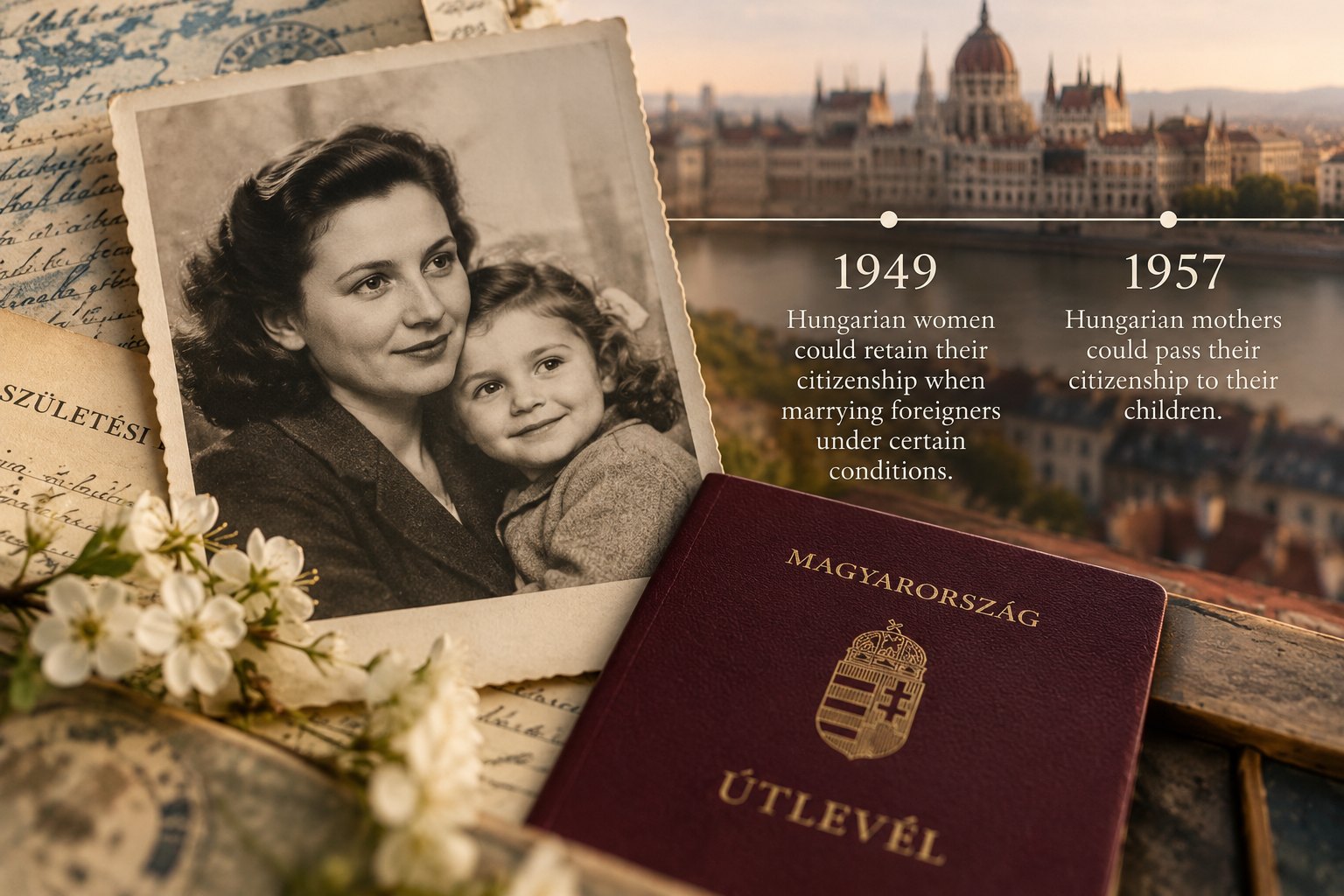
Can you obtain Hungarian citizenship through your mother or grandmother? Yes, but historical laws matter. From February 1949, Hungarian women could retain their citizenship when marrying foreigners under certain conditions. From October 1, 1957, married Hungarian mothers could also pass citizenship to their children. Those born earlier may qualify for citizenship by declaration, while their descendants generally require simplified naturalization. Children born after the 1957 reform, and their descendants, may qualify for citizenship verification if the citizenship chain remained intact.
Can you obtain Hungarian citizenship through your mother or grandmother?
Yes, but the answer depends on when your ancestors married, when their children were born, and which Hungarian citizenship laws applied at the time.
Today, Hungarian citizenship passes equally through mothers and fathers. A child born to a Hungarian citizen is generally Hungarian from birth, whether the Hungarian parent is the mother or the father.
Historically, however, Hungarian women did not enjoy the same citizenship rights as men.
Until the middle of the twentieth century, a woman's citizenship could be affected by her marriage, and even a woman who retained her Hungarian citizenship could not necessarily pass it to children born within that marriage.
Two important legislative changes, in 1949 and 1957, gradually altered this situation.
For descendants of Hungarian women, understanding these changes can determine whether they are already Hungarian citizens, can acquire citizenship by declaration, or must apply for simplified naturalization.
When Marriage Could Cost a Hungarian Woman Her Citizenship
For much of Hungarian legal history, married women's citizenship was closely connected to that of their husbands.
Before February 1, 1949, a Hungarian woman generally lost her Hungarian citizenship when she married a foreign citizen.
Conversely, a foreign woman who married a Hungarian citizen generally acquired Hungarian citizenship through that marriage.
These rules reflected the historical assumption that a married couple should share the husband's nationality.
The consequences could be significant.
Imagine a Hungarian woman who emigrated to the United States and married an American citizen in 1935.
Although she was born in Hungary and was a Hungarian citizen, her marriage to an American citizen in 1935 resulted in the loss of her Hungarian citizenship under the law then in force.
Consequently, her children did not acquire Hungarian citizenship through her. The Hungarian citizenship chain was broken at the time of her marriage.
When researching citizenship through a grandmother, her marriage certificate and the date of her marriage may therefore be just as important as her Hungarian birth certificate.
The 1948 Citizenship Law: A First Step Toward Equality
A significant change came with Act LX of 1948 on Hungarian Citizenship, which entered into force on February 1, 1949.
From that point, a Hungarian woman did not necessarily lose her citizenship merely because she married a foreign citizen.
Instead, the crucial question was whether she acquired her husband's nationality as a consequence of the marriage.
If she did not automatically acquire his foreign nationality, she could retain her Hungarian citizenship.
For example, suppose a Hungarian woman married an American citizen in 1950.
Under American nationality law at that time, marriage to an American citizen did not, by itself, automatically make a foreign wife an American citizen.
Consequently, if the Hungarian wife did not otherwise lose her Hungarian nationality, she could remain a Hungarian citizen despite being married to an American.
This represented an important change in the legal status of married Hungarian women.
But there was still a major inequality.
Although a married Hungarian woman could now retain her citizenship, she generally could not pass it to her children born within marriage if their father was a foreign citizen.
The reform of married women's citizenship therefore preceded the reform of citizenship transmission to their children.
October 1, 1957: Hungarian Mothers Gain Equal Rights to Pass on Citizenship
The next major change came with Act V of 1957 on Citizenship, which entered into force on October 1, 1957.
Under the new legislation, a child could acquire Hungarian citizenship at birth through either Hungarian parent.
For the first time under Hungary's modern citizenship laws, married Hungarian mothers and fathers were placed on an equal footing for transmitting citizenship to their children.
Previously, a child born within marriage generally acquired citizenship through the father. Children born outside marriage could acquire citizenship through their Hungarian mothers, subject to the historical rules concerning paternal recognition and legitimation.
After October 1, 1957, the distinction between Hungarian mothers and fathers was removed from the basic rule governing citizenship by descent.
However, the reform did not retroactively grant Hungarian citizenship to every child previously born to a Hungarian mother and foreign father.
This created a lasting difference between families whose children were born before and after October 1, 1957.
One Hungarian Mother, Two Children, Two Different Citizenship Histories
Consider a hypothetical family.
A Hungarian woman, born in Budapest in 1925, emigrates to the United States after the Second World War.
In 1950, she marries an American citizen.
She does not automatically acquire American citizenship through the marriage and retains her Hungarian citizenship.
The couple has two children:
A daughter born in New York in 1954.
A son born in New York in 1960.
Both children have the same Hungarian mother and American father.
Yet their Hungarian citizenship status is different.
The Daughter Born in 1954: Citizenship by Declaration
When the daughter was born in 1954, Hungarian citizenship law did not generally allow a married Hungarian mother to transmit citizenship to a child whose father was a foreign citizen.
Therefore, despite her mother's Hungarian citizenship, the daughter did not acquire Hungarian citizenship at birth.
Today, Hungarian law provides a special remedy for people in this situation.
Under Section 5/A(1)(c) of Act LV of 1993 on Hungarian Citizenship, a person born before October 1, 1957, to a Hungarian citizen mother and foreign citizen father, who did not acquire Hungarian citizenship at birth, may acquire Hungarian citizenship by declaration.
This procedure is known in Hungarian as állampolgárság megszerzése nyilatkozattal.
Unlike simplified naturalization, it does not require Hungarian-language proficiency.
But the declaration is an acquisition of citizenship in the present. It does not retroactively establish that the applicant was Hungarian from birth.
This distinction is essential when considering the citizenship rights of the next generation.
What About the Daughter's Children?
Suppose the daughter born in 1954 has a child in 1980.
If she was not a Hungarian citizen in 1980, her child did not inherit Hungarian citizenship through her at birth.
Even if the mother acquires Hungarian citizenship by declaration in 2026, that does not change her citizenship status at the time of her child's birth.
Consequently, her adult child cannot ordinarily obtain citizenship verification through this maternal line.
Instead, the adult child may qualify for simplified naturalization based on Hungarian ancestry, provided the statutory conditions are met, including sufficient Hungarian-language proficiency.
In other words, the mother may acquire Hungarian citizenship through declaration without speaking Hungarian, while her adult child generally needs to apply through simplified naturalization and demonstrate Hungarian-language proficiency.
The Son Born in 1960: Hungarian Citizenship by Birth
Now consider the younger sibling.
He was born in 1960, after the new citizenship law came into force.
Because his mother was still a Hungarian citizen when he was born, he acquired Hungarian citizenship at birth through her.
His American birthplace and his father's foreign nationality did not prevent this.
Even if he never obtained a Hungarian passport, he may already be a Hungarian citizen.
The appropriate procedure is therefore citizenship verification (állampolgárság igazolása), not naturalization.
He is not asking Hungary to grant him citizenship. He is asking the Hungarian authorities to confirm citizenship that he acquired at birth.
Hungarian-language proficiency is not required for citizenship verification.
What About the Son's Children?
Suppose the son born in 1960 has a daughter in 1985.
Because he was Hungarian from birth, his daughter also acquired Hungarian citizenship at birth, assuming her father retained his citizenship and no other historical circumstance interrupted the chain.
She, too, may apply for citizenship verification.
The fact that neither father nor daughter previously held a Hungarian passport does not, by itself, mean they were not Hungarian citizens.
This illustrates the importance of the 1957 reform.
The older sibling can acquire citizenship through declaration, but her descendants generally require naturalization. The younger sibling was Hungarian from birth and could transmit that citizenship to subsequent generations.
The difference is not their ancestry. It is the law applicable on their respective dates of birth.
Hungarian Citizenship Through a Grandmother: Why Her Marriage Date Matters
When examining eligibility through a Hungarian grandmother, three questions are particularly important.
First: Was she Hungarian when she married?
Her birthplace is a starting point, but she may have lost citizenship before her marriage through another historical legal mechanism.
Second: When did she marry, and did she acquire her husband's nationality?
A marriage before February 1, 1949, may have had different consequences from one celebrated after that date.
For marriages between February 1, 1949, and September 30, 1957, it is particularly important to establish whether the wife acquired the foreign husband's nationality automatically.
Third: When were her children born?
A child born within marriage before October 1, 1957, to a Hungarian mother and foreign father generally did not acquire Hungarian citizenship through the mother.
A child born on or after that date could acquire Hungarian citizenship through either parent.
These questions must be examined together.
It is entirely possible for a woman to have retained her Hungarian citizenship while some of her children did not acquire it at birth.
What If the Grandmother Married Before February 1, 1949?
The analysis becomes different if a Hungarian woman married a foreign citizen before the 1949 reform.
Under the earlier law, the marriage itself could have caused her to lose Hungarian citizenship.
The later reforms did not automatically reverse every citizenship loss that had already occurred.
Therefore, when a child was born after October 1, 1957, it is still necessary to establish that the mother was a Hungarian citizen on that child's date of birth.
The introduction of equal transmission rights in 1957 could not enable a woman who had already lost Hungarian citizenship and had not reacquired it to transmit citizenship she no longer possessed.
In these families, additional research into marriage, nationality, naturalization, and possible reacquisition of Hungarian citizenship may be necessary.
Which Hungarian Citizenship Procedure Applies Today?
These historical changes produce three distinct legal pathways.
1. Hungarian Citizenship Verification
Állampolgárság igazolása
This applies when the applicant already acquired Hungarian citizenship at birth and the citizenship chain remains intact.
For example, a person born in 1965 to a Hungarian mother who retained her citizenship may already be Hungarian, as may that person's children.
There is no Hungarian-language requirement for citizenship verification.
2. Acquisition of Citizenship by Declaration
Állampolgárság megszerzése nyilatkozattal
This special procedure may apply to someone personally born before October 1, 1957, to a Hungarian citizen mother and foreign father, who did not acquire Hungarian citizenship at birth.
There is no Hungarian-language requirement under this provision.
However, citizenship acquired through declaration does not ordinarily pass retroactively to children born before the parent's acquisition of citizenship.
3. Simplified Naturalization
Egyszerűsített honosítás
This may apply to descendants whose Hungarian citizenship chain was interrupted by historical legislation, including the former restrictions on maternal transmission.
The applicant must satisfy the relevant statutory requirements, including Hungarian-language proficiency.
The appropriate procedure is determined by the individual's legal citizenship history, not simply by the fact that the family has a Hungarian ancestor.
Read more: Hungarian Citizenship by Descent: Verification or Simplified Naturalization?
Professional Assistance With Hungarian Citizenship Through Maternal Ancestry
A Hungarian mother or grandmother can provide a direct legal connection to Hungarian citizenship. But establishing that connection requires understanding how citizenship law changed over generations.
I specialize in Hungarian citizenship by descent and complex genealogical research, particularly for Jewish families whose histories involve emigration, changing borders, and incomplete documentation.
My work combines archival research, historical citizenship analysis, and the preparation of the documentation necessary for the appropriate Hungarian citizenship procedure.
If your mother or grandmother was Hungarian, I can help establish whether your family qualifies for citizenship verification, acquisition by declaration, or simplified naturalization.
Book a Professional Consultation
This article provides general information. Hungarian citizenship eligibility depends on the laws in force when the relevant events occurred and on the family's individual circumstances.
Legal and Official References
Act LX of 1948 on Hungarian Citizenship (1948. évi LX. törvénycikk)
Act V of 1957 on Citizenship (1957. évi V. törvény)
Embassy of Hungary in London — General Information on Hungarian Citizenship
Hungarian Consulate General in New York — Verification of Hungarian Citizenship
Embassy of Hungary in The Hague — Acquisition of Citizenship by Declaration
 Anett Neumann, MScHungarian Citizenship Consultant & Professional Genealogist · formerly Anett Goldstein ·