Did Hungarian Jews who emigrated in the 1930s lose their Hungarian citizenship? Not necessarily. This case study follows a young emigrant to the 1932 Maccabiah Games and shows how historical citizenship law, a 1937 electoral register, and archival discoveries across several countries helped establish his descendant's Hungarian citizenship.
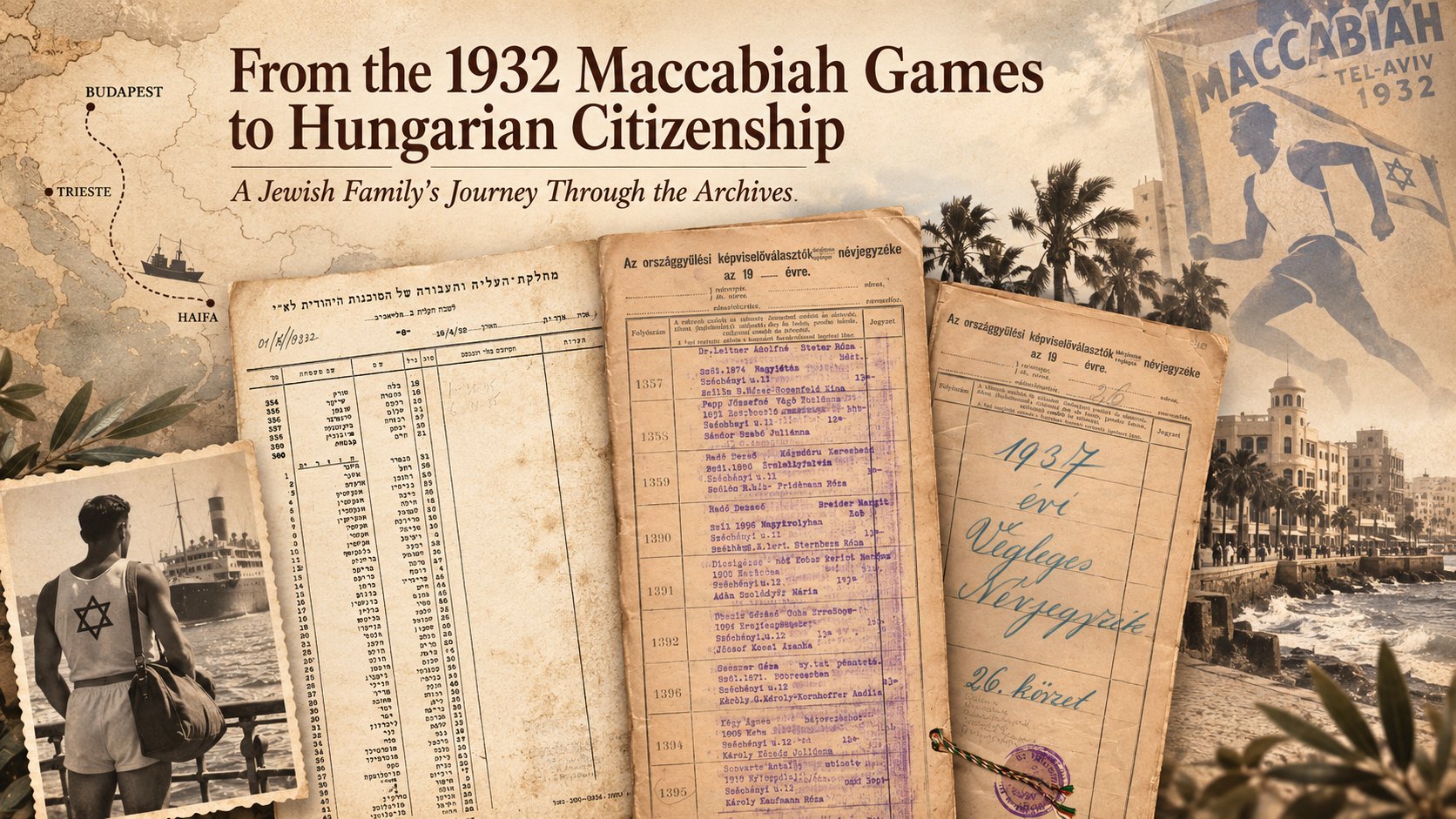
In 1932, a nineteen-year-old Hungarian Jew named Béla Schwarcz left Hungary for Mandatory Palestine, travelling in connection with the first Maccabiah Games.
He was born in Nyírgyulaj, a small village in northeastern Hungary, into a Jewish family whose roots in the region extended back centuries. In Palestine, he would adopt a new name, Haim Sade, and establish a family.
Almost a century later, his journey became central to an investigation into whether his descendants had inherited Hungarian citizenship.
The research would take us from a 1937 electoral register in Debrecen to a marriage certificate discovered in a Ukrainian archive, and from historical immigration records to civil registration documents from British Mandatory Palestine.
But this was no ordinary family history.
Béla's nephew was Charles Fenyvesi, the Hungarian-born American journalist and author of When the World Was Whole: Three Centuries of Memories, a remarkable account of their family's history.
That history, preserved in literature and a 1994 Hungarian newspaper interview, offered a glimpse into generations of Hungarian Jewish agricultural life, the loss of the family's estate, and the upheavals of the twentieth century.
My task, however, was different: to transform this extraordinary family history into the documentary evidence required for Hungarian citizenship verification.
The investigation ultimately resulted in the successful verification of my client's Hungarian citizenship.
A Hungarian Jewish Family Whose History Became a Book
In October 1994, the Hungarian newspaper Kelet-Magyarország published an interview with Charles Fenyvesi titled Mikor kerek volt a világ — When the World Was Whole.
Written by journalist Sándor Marik, the article recounts Fenyvesi's memories of a Jewish family whose history was intimately connected to the villages of Nyírderzs and Nyírgyulaj in Szabolcs County.
The most fascinating aspect of this history is that the Schwarcz family were agricultural landowners.
Jewish life in historical Hungary is often associated with merchants, craftsmen, rabbis, and urban professionals. Yet the Schwarcz family belonged to a different tradition: generations of Jewish farmers who cultivated land and developed deep connections with their rural communities.
According to Fenyvesi, one of his ancestors, a man named Dániel, acquired approximately twenty Hungarian hold of sandy land in Nyírderzs at a time when Jewish landownership was restricted.
The land was initially of poor quality, but he improved it, and subsequent generations considerably expanded the family estate.
The history of this land became inseparable from the history of the family itself.
Fenyvesi's grandfather was Schwarcz Károly, Béla Schwarcz's father.
The 1994 newspaper article includes an extraordinary archival portrait of Károly, taken in 1891, when he was thirty years old.
For Béla's descendants, this is much more than a historical illustration. It is a photograph of their direct ancestor, preserved in a newspaper article published decades after his death.
Fenyvesi reconstructed the family's history in his book When the World Was Whole: Three Centuries of Memories, first published in English in 1990 and subsequently translated into several languages, including Hungarian.
The book follows generations of Hungarian Jews through periods of relative prosperity, social transformation, and ultimately tragedy.
In the newspaper interview, Fenyvesi recalled how the family's agricultural enterprise went bankrupt and his branch of the family left Nyírderzs in 1927.
The family's long-established world was changing.
Five years later, Béla Schwarcz would leave Hungary altogether, travelling to Mandatory Palestine in connection with an event that would become part of Jewish history.
The First Maccabiah Games: The Aliyah Olympics
The first Maccabiah Games opened in Tel Aviv on 28 March 1932.
According to the official history of the Maccabiah, approximately 390 athletes from eighteen countries participated in the Games.
The event represented far more than an international sporting competition.
For Jews across Europe, the Maccabiah offered an opportunity to visit Mandatory Palestine, strengthen Jewish national identity, and experience the developing Jewish community there.
The early Maccabiah Games also became associated with immigration.
Some of those who travelled to Palestine in connection with the competitions decided to remain rather than return to Europe.
The first two Maccabiah Games, held in 1932 and 1935, became associated with the term Aliyah Maccabiot. The nickname Aliyah Olympics became particularly well known in connection with the second Games in 1935.
Béla Schwarcz was among the young Hungarian Jews whose journey to Palestine was connected with the first Games.
He was born on 14 January 1913 in Nyírgyulaj, the son of Károly Schwarcz and Róza Kaufmann.
His arrival in Mandatory Palestine is documented in historical immigration records preserved by MyHeritage.
At the time, he was only nineteen years old.
He remained in Palestine and later adopted the Hebrew name Haim Sade.
There, he married and established a new family.
But while his life had moved away from Hungary, a legal question remained: had he retained his Hungarian citizenship, and could that citizenship pass to his descendants?
Answering this question required an investigation into Hungarian citizenship legislation as it existed almost a century ago.
Why September 1, 1929 Matters for Hungarian Citizenship
Hungarian citizenship by descent is primarily governed by the principle of jus sanguinis: citizenship is transmitted from parent to child.
However, proving that an ancestor was born in Hungary does not automatically establish that their descendants are Hungarian citizens.
The citizenship status of each generation must be examined under the legislation applicable at the relevant time.
For families whose ancestors emigrated during the interwar period, one particularly important date is 1 September 1929.
According to the Hungarian Consulate General in New York's official citizenship verification guidance, applicants whose ancestors emigrated before 1 February 1949 are generally required to provide Hungarian documentation establishing that the ancestor lived in Hungary after 1 September 1929.
The requirement relates to historical provisions governing the loss and retention of Hungarian citizenship, including the consequences of prolonged residence abroad.
Since Béla emigrated in 1932, his departure occurred after this significant date.
However, his case involved another legal consideration that required careful investigation.
Although Béla was nineteen years old, he was still considered a minor under Hungarian law.
Why Béla's Age Changed the Legal Analysis
Today, a nineteen-year-old is legally an adult in Hungary and most other countries.
In 1932, however, the ordinary Hungarian age of majority was generally twenty-four.
Béla was therefore still legally a minor when he left Hungary.
This was important because historical citizenship rules concerning minors could differ from those applying to adults, and a parent's citizenship circumstances could affect the legal analysis.
We had to establish what had happened to his parents and whether the relevant family circumstances supported continuity of Hungarian citizenship.
Béla's father, Károly Schwarcz, had died on 18 March 1920 in Nyírgyulaj, when Béla was only seven years old.
His death is documented in a historical Hungarian death record available through FamilySearch.
This presented a complication.
Because Károly had died before September 1929, we could not establish his continued presence in Hungary after the relevant date.
The investigation therefore turned to Béla's surviving mother, Róza Kaufmann.
Could we find reliable evidence that she had remained in Hungary after her son emigrated?
And could we establish that the woman appearing in any such record was indeed Béla's mother?
The answer came from an unexpected source.
The Breakthrough: A 1937 Electoral Register in Debrecen
One of my researchers located an entry in the 1937 electoral register of Debrecen identifying Béla's widowed mother.
This was one of the most important discoveries in the entire investigation.
The register placed Róza Kaufmann in Hungary in 1937, five years after Béla's departure for Palestine and almost eight years after the September 1929 reference date.
At a time when we were searching for evidence relevant to the family's continued connection to Hungary, the electoral register supplied an important piece of the puzzle.
What makes this discovery especially interesting is that electoral registers are not the most obvious sources for citizenship research.
Most applicants expect to rely on birth certificates, marriage certificates, passports, or other official identity documents.
Yet historical electoral registers can preserve valuable information about individuals, including names, ages, occupations, and places of residence.
In this case, the register also demonstrated the importance of understanding Hungarian naming conventions.
Historically, Hungarian married women were frequently recorded under their husbands' names.
The suffix -né indicated a married woman, while the abbreviation özv. (from özvegy) indicated widowhood.
A woman born Róza Kaufmann could therefore appear in official records as özv. Schwarcz Károlyné — the widow of Károly Schwarcz.
Without an understanding of these conventions, a researcher searching for the name Róza Kaufmann might easily overlook a crucial document.
The 1937 register was a breakthrough, but it did not resolve every issue.
We still had to prove that the woman recorded in Debrecen was the same Róza Kaufmann who was married to Károly Schwarcz and was the mother of Béla.
For that, we needed another document.
The Missing Marriage Certificate: From Slovakia to Ukraine
The next objective was to locate the marriage record of Károly Schwarcz and Róza Kaufmann.
This document was essential for connecting the family members identified in the different archival sources.
It was also important for another reason: the marriage entry could establish Károly's birthplace, information that was not necessarily included in Béla's 1913 birth record.
We began the search in Slovakia.
Róza Kaufmann had been born in Tőketerebes, today Trebišov, Slovakia.
It was reasonable to begin by investigating the local and regional archives associated with her birthplace.
However, the marriage record was not found there.
This is a recurring challenge in Hungarian Jewish genealogical research.
Before the Treaty of Trianon in 1920, the Kingdom of Hungary extended far beyond the borders of present-day Hungary.
Towns that are now situated in Slovakia, Ukraine, Romania, Serbia, and other neighbouring countries belonged to the same historical state.
Families moved between these communities, and the place where a couple married was not necessarily the birthplace of either spouse.
Eventually, our investigation led to Ungvár, today Uzhhorod in Ukraine.
It was there, in a Ukrainian archival collection, that we located the marriage record of Károly Schwarcz and Róza Kaufmann.
Although the document is now preserved in Ukraine, the marriage took place within the historical Kingdom of Hungary.
The discovery provided a crucial link between the Hungarian family records and the woman identified in the 1937 Debrecen electoral register.
It also supplied additional biographical information about Béla's father.
What had initially appeared to be a missing Hungarian marriage certificate required research across several modern national jurisdictions.
This is precisely why professional Hungarian Jewish genealogy requires an understanding of historical geography rather than reliance on present-day borders.
From Béla Schwarcz to Haim Sade: Reconstructing the Palestinian Records
Finding the Hungarian marriage record was a major step, but it was not the end of the investigation.
We still needed to establish the documentary continuity between Béla Schwarcz, born in Hungary in 1913, and Haim Sade, the man who later lived in Mandatory Palestine.
Like many Jewish immigrants of his generation, Béla adopted a Hebrew name after emigrating.
For citizenship verification, this created an additional evidentiary challenge.
A Hungarian birth certificate might identify an individual by a Hungarian or Germanic name, while subsequent marriage records, children's birth certificates, and other documents use a completely different Hebrew name.
To establish Hungarian citizenship through descent, the authorities need to be able to follow the same individual across the relevant documents.
In this case, we located Béla's name-change documentation.
We also obtained his 1939 marriage certificate from Mandatory Palestine.
These records established the connection between his original Hungarian identity and his later life as Haim Sade.
They also allowed us to connect the subsequent generations to their Hungarian ancestor.
The documentary chain was now approaching completion.
A Family Story Preserved in Literature — and Reconstructed Through Archives
One of the most rewarding aspects of this case was the relationship between the family's published history and the archival evidence.
Charles Fenyvesi had already preserved the Schwarcz family's story in When the World Was Whole.
His book described the family's agricultural roots, its relationship with the surrounding communities, and the dramatic changes that transformed Hungarian Jewish life.
The 1994 newspaper interview also recounts Fenyvesi's own experiences during the Holocaust.
He described how a sympathetic official in Debrecen helped provide false identity documents that enabled him and his mother to survive in Budapest.
More than seventy members of the extended family, he recalled, were murdered during the Holocaust.
Fenyvesi later lived through the Hungarian Revolution of 1956, left Hungary, and established a successful journalistic career in the United States.
His uncle Béla had followed a different path, leaving Hungary twenty-four years earlier for Mandatory Palestine.
Their lives reflect two very different experiences within the same Hungarian Jewish family.
Yet the family's history, however richly documented in literature, could not by itself establish the legal facts necessary for citizenship verification.
A family memoir is a valuable historical source, but genealogical relationships and citizenship status must be supported by appropriate documentary evidence.
Our investigation therefore brought together two complementary forms of historical knowledge.
The family's published history explained the world from which Béla came.
The archival records established the identities, relationships, and historical circumstances necessary for his descendant's Hungarian citizenship application.
The Completed Documentary Chain
By the end of the investigation, we had assembled evidence from Hungary, Ukraine, and Israel, following research that had also taken us into Slovak archival collections.
The central documents included:
Béla Schwarcz's Hungarian birth record, establishing his birth and parentage.
Károly Schwarcz's death record from 1920, documenting his father's death before the relevant 1929 date.
The 1937 Debrecen electoral register, providing evidence of his widowed mother's presence in Hungary.
The marriage record of Károly Schwarcz and Róza Kaufmann, located in Ungvár, connecting the historical identities and providing additional genealogical information.
The 1932 immigration record, documenting Béla's journey to Mandatory Palestine.
His name-change documentation, connecting Béla Schwarcz with Haim Sade.
His 1939 marriage certificate from Mandatory Palestine, together with subsequent civil records establishing the family line to my client.
Each document addressed a different question.
The electoral register helped establish the mother's connection to Hungary after 1929.
The marriage record strengthened the identification of the correct family.
The Palestinian documents connected Béla's two identities.
And the subsequent records established the chain of descent.
The result was a coherent body of evidence that could be assessed under the relevant Hungarian citizenship legislation.
Once the necessary certificates had been located and issued, the application was submitted, and my client's Hungarian citizenship was successfully verified.
This was a citizenship verification case, rather than an application for simplified naturalization.
The distinction is important: citizenship verification concerns recognition of an existing Hungarian citizenship status, while simplified naturalization is a separate procedure through which an eligible applicant may acquire citizenship, generally subject to a Hungarian language requirement.
What This Case Teaches Us About Hungarian Citizenship by Descent
Many descendants of Hungarian Jewish families assume that their ancestors' emigration, the passage of time, or the disappearance of family documents makes Hungarian citizenship impossible to establish.
That is not necessarily the case.
The decisive question is whether Hungarian citizenship was retained and transmitted through the generations under the legislation applicable at the time.
For families whose ancestors emigrated during the interwar period, details that initially seem insignificant may prove essential.
An ancestor's age when leaving Hungary, the death of a parent, a mother's continued residence, or a marriage record preserved in an archive outside present-day Hungary can all affect the investigation.
This case also demonstrates the value of sources beyond the conventional birth, marriage, and death registers.
Historical electoral lists, municipal records, immigration documents, and name-change records may contain information that is essential to establishing the legal history of a family.
For descendants of Hungarian Jewish families, the research can be particularly complex because historical records are frequently dispersed across several countries.
The ability to locate and interpret them requires specialised knowledge of Hungarian and Jewish genealogy, historical borders, archival systems, naming conventions, and the relevant citizenship laws.
Equally important is knowing which questions the documents must answer.
Genealogical research undertaken for citizenship verification is not simply about collecting certificates.
It is about constructing an evidence-based account of how citizenship passed from one generation to the next.
From the 1932 Maccabiah Games to Hungarian Citizenship
When Béla Schwarcz left Hungary in 1932, he was nineteen years old.
He travelled to Mandatory Palestine in connection with the first Maccabiah Games, joined a growing Jewish community, adopted a Hebrew name, and built a new life.
Behind him lay generations of Hungarian Jewish history: the agricultural estate in Nyírderzs, the family's attachment to its land, and a world that would soon be transformed beyond recognition.
His nephew Charles Fenyvesi would later preserve much of that history in a celebrated family memoir.
Almost a century after Béla's departure, archival research allowed us to reconstruct the documentary trail linking his Hungarian origins to his descendants.
The most important discovery was not a forgotten passport or an old citizenship certificate.
It was an electoral register from Debrecen, dated 1937, which helped establish a crucial element of his mother's history.
Combined with the marriage record located in Ukraine and the records from Mandatory Palestine, that evidence made it possible to complete the citizenship investigation.
For me, this case illustrates what makes Hungarian Jewish genealogical research particularly meaningful.
It is an opportunity not only to establish family relationships, but also to understand how those families lived, moved, survived, and maintained their identities across generations.
And when that historical understanding is combined with the appropriate legal analysis and documentary evidence, the result can be more than a reconstructed family history.
In this case, it led to the successful verification of a descendant's Hungarian citizenship.
Could Your Hungarian Jewish Ancestry Establish Your Citizenship?
Many descendants of Hungarian Jewish families may have a claim to Hungarian citizenship without realising it.
Whether citizenship can be verified depends on the family's history, the relevant legislation, and the available documentary evidence.
I specialise in Hungarian citizenship by descent and Hungarian Jewish genealogy, combining professional archival research with a detailed understanding of Hungarian citizenship legislation and administrative procedures.
My work includes complex cases involving historical border changes, missing civil records, Jewish family histories, emigration, and changes of name.
If your family left Hungary before or during the Second World War, a professional consultation can help determine which citizenship route may apply and what evidence is required.
Book a Professional Consultation
Anett Neumann, MSc
Hungarian Citizenship Consultant & Professional Genealogist
MSc Genealogical, Palaeographic and Heraldic Studies, University of Strathclyde
Hungarian Citizenship by Descent & Jewish Genealogy — From Ancestry to Application
 Anett Neumann, MScHungarian Citizenship Consultant & Professional Genealogist · formerly Anett Goldstein · , updated